
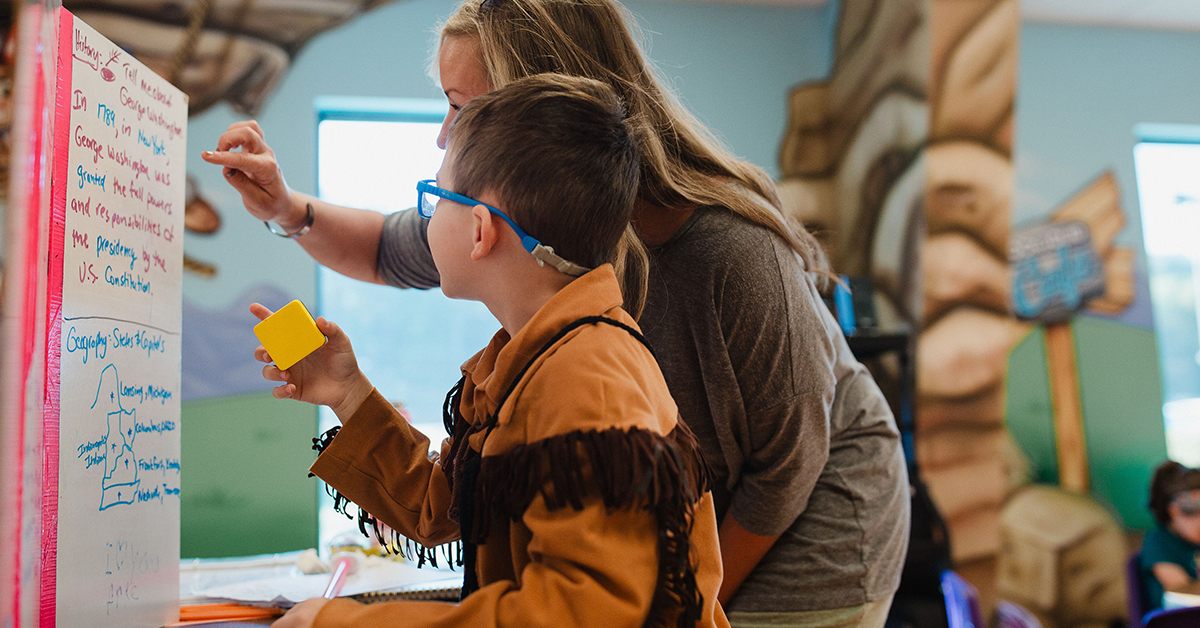
Every week, students gather in Classical Conversations Foundations communities to sing songs, chant facts, and recite memory work-this is CC Foundations grammar. If you peek into the room, you might see hand motions, hear laughter, and catch the rhythm of a timeline song or math chant echoing down the hall. To the casual observer, it may look simply like play, but if you look more closely, there is something much deeper happening at the same time. As tutors and parents introduce memory work to our Foundations students, they are planting seeds.
The New Grammar portion of Foundations is focused on memorization. History sentences, Latin endings, English grammar rules, math facts, science definitions, geography locations– each is a seed sown into the rich soil of our children’s minds and hearts. At first, the seeds may seem small or even hidden. But in time, they take root, sprout, and blossom into knowledge, understanding, and ultimately, into wisdom.
Planting Seeds: Understanding New Grammar in Classical Conversations
One of the most common concerns many Foundations parents share is, “But my children don’t really understand what they’re memorizing. Does it matter?”
The answer is: Absolutely. Seeds don’t bear fruit the day they’re planted, and neither does knowledge. An eight-year-old boy reciting Latin declensions may not understand how those endings work in a sentence– yet. A six-year-old girl may not understand how a+b=b+a works as the commutative law – yet.
But when those facts are tucked away in memory, they become building blocks for the later years of Challenge. When a Challenge student studies Latin translations, history or timeline analysis, or algebra equations, the memory work from Foundations is already there, waiting to be connected. God designed our brains with an awe-inspiring capacity to memorize, and He also provided the tools within our very biology that make that act possible and even delightful.
Remember this, however: Memorization is not the end goal; it’s the foundation. In His omniscience, God also designed us to store knowledge so that we can connect it, understand it, and ultimately apply it with wisdom. Proverbs 2:10 says,
“For wisdom will enter your heart, and knowledge will be pleasant to your soul.”
Memorization fills the storehouse; wisdom draws from it. So, take heart. As a Foundations parent, your job in this season is not to force instant mastery or to expect wisdom. Instead, it is to plant seeds faithfully for seasons yet to come.
Have fun Mixing Up the Memory Work
Watering the Soil: How CC Foundations Grammar Uses Repetition
Just as plants need water to grow, memory work needs repetition to stick. That is the primary reason why New Grammar is sung, chanted, and reviewed week after week. The rhythms and tunes may feel silly at times, but they are carefully chosen tools that help knowledge cling to a child’s long-term memory.
If you’ve ever found yourself humming a math skip-counting song while doing dishes or busted out the timeline song in the shower, you’ve experienced how effective this can be. Repetition, especially when paired with music and movement, keeps information alive until a child is ready to use it.
Encourage your children to sing the songs in the car, practice with hand motions at home, or even teach the material back to you. Each small review session is like another drink of water for the memory work seeds in their minds.
Parents as Faithful Gardeners in the Grammar Stage Homeschool
The good news? You do not need to be an expert in Latin, geography, or math facts to help your children thrive in New Grammar. Your role is more like that of a gardener: to plant consistently, to water regularly, and to trust the process of gradual growth over time.
- Play 30 Minutes a Day: Two 10 to 15 minutes of daily review (up to 30 minutes in total within a day) works better than a long cram session.
- Model joy, not stress: Your attitude shapes your children’s. If you sing with a smile, they will too. Have fun!
- Celebrate small wins: Did your children remember half the timeline song this week? Wonderful! Seeds are growing.
Also, do not forget to use the Five Core Habits of Grammar (Naming, Attending, Memorizing, Expressing, and Storytelling) as you reflect on and review your memory work at home. Here are some practical ways this can be accomplished:
Using the Five Core Habits with CC Foundations Grammar
Naming
A simple way to do this is to point out and name what your children are learning. For example, you may say before repeating the memory work, “This is the Latin first declension ,” or “That’s the 5s multiplication table.” Naming helps anchor information with labels, providing mental memory pegs on which to hang information as learning takes place. At home, as you review, always say the category: For example, you may say, “We’re practicing indefinite pronouns and prepositions today!”
Attending
Direct your children’s attention**** to the new information by minimizing distractions and using focus cues (clapping rhythms, hand motions, eye contact). At home, you can use hand motions or props (like puppets for Latin recitations or globe stickers for geography). For example, when skip counting, you may pause and ask, “Did you hear the pattern in that chant?” to train focus. Your goal is to help your children intentionally slow all of their senses to notice and thoughtfully consider the details.
Memorizing
Memorization truly is the heart of New Grammar. Children store facts in their mental libraries through repetition, rhythm, and recitation. Though you may be tempted to complicate the process, it is helpful to remember to keep things simple. For instance, sing CC memory work songs in the car while driving to run errands. To mix things up, you can play a “fill in the blank” game by providing a portion of the memory work and having your children fill in the rest. For example, you may sing, _“In 1492, Columbus made the first of __trips…” As you review, opt to do it in little bursts and often rather than in long stretches. Your child’s memory will latch on more easily through the repetition of information spread over a longer duration of time.
Listen to Memorizing Tips and Tricks on the Everyday Educator podcast
Expressing
Encourage your children to use their own words, voices, and creativity to play with what they’ve memorized. When this occurs, they take ownership over the information in a new way. For example, you can ask them recite history sentences in silly voices (robot, opera singer, whisper). Let them clap or drum the rhythm of math facts. For younger students, you may ask them to teach the week’s New Grammar to a sibling, stuffed animal, or even to you.
Storytelling
This habit connects memory work to a bigger picture by wrapping it into a story. For instance, you may link history sentences into a simple timeline story: “First Columbus sailed, then the pilgrims came, then the Declaration of Independence was signed…” You may also tie science definitions into a narrative: “Imagine a scientist who discovers how the body digests food. That’s why we memorize the parts of digestive system!” You can even review geography by telling travel “stories” that link locations together.
Using the Five Core Habits of Grammar at home turns review from repetition into engaging, whole-brain learning. Each habit adds a layer: naming gives clarity, attending sharpens focus, memorizing builds storage, expressing makes it fun, and storytelling gives it meaning. As you practice these Core Habits, keep one thing in mind: faithfulness beats perfection every time.
Discover more about the Five Core Habits of Grammar
From Roots to Fruit: The Long-Term Benefits of Grammar in Classical Education
The most exciting part of New Grammar is what happens later. Those early seeds of memory work eventually sprout into visible fruit. The multiplication facts chanted in Foundations suddenly become essential in higher-level mathematics. The timeline of world history memorized in songs now provides a framework for understanding revolutions, wars, and leaders in depth. The Latin endings once chanted with no context now unlock the beauty of translation and grammar analysis.
Parents often marvel when they see these connections click into place. The memory work you may have wondered about in Foundations becomes the very tools your children need to thrive later.
Learn the New Grammar in the Foundations Fifth Edition, English Language Curriculum
Trusting the Harvest
Some days, practicing New Grammar may feel routine, or even mundane. Your children may wiggle during chants or roll their eyes at yet another song, and that’s okay. Seeds are still being planted. Growth is often invisible at first, but it is happening underground.
Take courage in knowing that this method has been tested over time. Ancient thinkers like Socrates, Plato, Jesus’ disciplesh relied on memorization and recitation because it truly works. More importantly, when you practice New Grammar at home, you’re not just drilling facts — you’re working with God’s design. You’re training your child’s memory muscles, using rhythm and song, attaching joy to learning, and preparing their hearts and minds for wisdom. What feels simple today is profound preparation for tomorrow.
So, the next time your children burst into a timeline tune in the backseat or chants Latin declensions while brushing their teeth, smile. Those are knowledge seeds being watered. One day, they will grow into a flourishing garden of understanding, ready to bear fruit in season. As you wait, keep planting, keep watering, and trust the harvest. Your faithfulness today is cultivating the wisdom of your children for tomorrow.
New Grammar Wrap Up
- Memorization builds the foundation : Students memorize Latin, timeline songs, and facts before understanding them. These become building blocks for advanced Challenge studies.
- Repetition through rhythm works : Songs, chants, and movement help knowledge stick. Daily 10-15 minute sessions beat long cram sessions.
- The Five Core Habits enhance learning : Use Naming, Attending, Memorizing, Expressing, and Storytelling to turn review into engaging, whole-brain learning.
- Trust the process : Grammar stage methods rely on consistent, joyful practice rather than immediate mastery. Early memory work grows into wisdom over time.
Want to learn more about classical education? Check out these helpful resources:
- Mastering the 15 Classical Skills: A Parent’s Guide to the Trivium
- What are the Five Core Habits of Grammar?
- What are the Five Common Topics of Dialectic?
- What are the Five Canons of Rhetoric?
Written by:

Kelli Wilt
Lead of Program Development for Classical Conversations Multimedia
Kelli Wilt lives in Charlotte, North Carolina, with her husband, Ken. Driven by a love for God and a desire to make Him known, she has devoted her life to nurturing faith and learning in families. After beginning her career as a public school kindergarten teacher, Kelli embraced homeschooling with Classical Conversations in 2009. Serving as a Foundations and Essentials director, Foundations tutor, Essentials tutor, and Challenges B, I, III, and IV director, she has personally guided her three children to complete their educations with confidence and joy. She has also served as both the Foundations and Essentials Academic Advisor as well as created engaging content for videos, e-zines, and other educational resources. Today, she is the Lead of Program Development for Classical Conversations Multimedia, emcees the National Memory Master Competition, and co-hosts the Everyday Educator podcast—continuing to inspire families in Christ-centered education.
I'm Ready To Homeschool
I want to start homeschooling!
A Classical Conversations team member will contact you shortly to help you learn more about enriching your child’s classical, Christian homeschool education.